The ATS Rejection Myth: 92% of Recruiters Confirm Your Resume Is NOT Auto-Rejected
Millions of job seekers have been optimizing their resumes based on a statistic with zero academic backing. Here's what actually happens to your resume — and why the real problem is far more nuanced.
Compartir artículo:
The ATS Rejection Myth: 92% of Recruiters Confirm Your Resume Is NOT Auto-Rejected
For the past decade, one statistic has dominated career advice content, LinkedIn posts, and resume service marketing:
"75% of resumes are rejected by ATS bots before a human ever reads them."
It's been cited by Forbes. Shared by career coaches. Printed in job hunting guides. And it is, according to the most comprehensive recruiter research to date, almost certainly false.
Here's what actually happens to your resume — and why the truth matters far more for your job search strategy.
Where the "75% ATS Rejection" Myth Comes From
HR consultant Christine Assaf did what most people sharing this statistic never bothered to do: she traced it to its source.
The figure traces back to a single company: Preptel — a resume services business that shut down in August 2013. The statistic was published without any disclosed methodology, sample size, or peer review. It was, in the language of research, unsourced marketing copy.
Yet somehow, it became the foundational "fact" of the modern job hunting industry.
- 68% of recruiters surveyed by HR.com said they first encountered the myth from job seekers on social media
- 20% traced it to career coaches and resume blogs recycling the figure without verification
- 12% pointed to unsourced mainstream media headlines
When Assaf searched Google Scholar — the world's largest database of academic research — she found zero peer-reviewed studies supporting any specific percentage of ATS auto-rejection.
The myth had been repeated so many times that it had become "common knowledge." It was never real.
Get the Truth About Your Resume
Instead of optimizing for a myth, see exactly how your CV performs against real ATS systems used by Fortune 500 companies — in 60 seconds.
What 25 Corporate Recruiters Actually Said
In September and October 2025, Enhancv surveyed 25 corporate recruiters at U.S. companies across multiple industries. The results directly contradict the myth.
92% (23 of 25) confirmed that their ATS does NOT automatically reject resumes based on formatting, design, or content.
Only 2 recruiters (8%) had auto-rejection configured — and even those were using strict, human-defined thresholds:
- One used Bullhorn set to reject candidates with a job title match below 75%
- One used BambooHR set to reject candidates missing 3+ of 10 listed required skills
Both configurations were deliberate business decisions, not default ATS behavior.
What 100% of recruiters did confirm: They use "knockout questions" — mandatory Yes/No eligibility questions — to filter for basic requirements like:
- Legal authorization to work
- Required professional licenses
- Physical location or willingness to relocate
- Minimum years of experience for licensed roles
But this isn't an ATS "rejecting your resume." It's a human-designed form with binary eligibility gates — the same concept as any application form.
What about AI scoring? 44% of the ATS platforms used by surveyed recruiters offer AI "fit scores." Of those:
- 36% use the scores as guidance, with manual verification before any decisions
- 8% use them as a hard filter
- 56% ignore the feature entirely
"We don't want to miss out on a qualified applicant." — Crystal Hughes, Accuserve Solutions
"The ATS systems I've worked with don't automatically disposition people — we have to go in and do it." — Charkin Whitehead, Allegis Global Solutions
So Why Aren't You Getting Callbacks?
If the bots aren't mass-rejecting your resume, why is the job market so brutal? The answer is volume — and it's actually a harder problem to solve.
The Scale Is Incomprehensible
Here is what modern job applications actually look like:
| Role Type | Typical Applicants | |---|---| | Entry-level | 400–600 | | Customer service / remote | 1,000+ in first week | | Tech / software engineering | 2,000+ per remote role | | Senior / niche roles | Under 200 |
These aren't edge cases. On LinkedIn alone, 11,000 job applications are submitted every single minute. Only approximately 8 people are hired per minute. That's roughly 1,000+ applications per hire on the platform.
The Interview Rate Has Collapsed
This is the real crisis, and it's documented by hard data:
- 2016: 15.3% of applicants received interview invitations
- 2024: 3% of applicants received interview invitations
That's an 80% decline in interview rates in 8 years — driven primarily by the explosion of "Easy Apply" tools that let candidates submit applications with a single click. The supply of applications has become infinite. The number of jobs has not.
"Three interviews, a case study, and then silence. Did I imagine the whole thing?" — r/RecruitingHell
"After three rounds, they sent me an auto-rejection. No name, just 'Dear Applicant.'" — r/jobs
One documented Reddit case: 1,782 applications over 14 months → 1,400+ rejections → 200+ ghostings → 1 job offer.
<!-- CTA:banner:Make Your Application Count in a 250:1 Market:When recruiters spend 6–8 seconds on each resume, your CV needs to be immediately compelling. Our AI builds resumes that pass both ATS parsing AND human attention.:Build a Standout Resume:prod_T4VXUqGub2thrS:false:true -->The Human Filter: What Recruiter Actually Do With Your CV
Once your resume passes any automated filters (mostly the knockout question gates), it enters a human review queue where the real filtering happens — and it happens fast.
How recruiters actually process applications:
- 52% review applications in arrival order — meaning timing matters enormously
- Recruiters spend an average of 6–8 seconds on an initial resume scan
- Less than 5% of recruiters spend more than 1 minute on any single resume
- Most recruiters pause postings after receiving 500–1,000 applications — meaning if you apply late, your resume may never be seen at all
What they're looking for in those 6–8 seconds:
| Priority | % of Recruiters | |---|---| | Clear, skimmable structure | 92% | | Relevant experience / skills visible immediately | 88% | | Natural keyword usage (not stuffing) | 76% | | Short, scannable bullet points | 72% | | Simple formatting (easy to read fast) | 68% | | Measurable achievements | 52% |
The implication is clear: your resume doesn't fail because a bot rejects it. It fails because a human scanning it in 7 seconds can't immediately confirm you're qualified.
This is actually a more fixable problem than fighting a mythical algorithm — it's a communication and design challenge.
What ATS Actually Does — Parsing vs. Rejecting
Here's the crucial distinction that the myth conflates: ATS systems parse resumes, they don't inherently reject them. There's a significant difference.
Parsing = extracting and organizing information from your resume (name, email, job titles, dates, skills) into a structured database that recruiters can search.
Rejecting = removing a candidate from consideration entirely.
ATS systems do the first automatically. The second is done by humans, usually based on:
- Knockout question responses
- Keyword searches that your resume doesn't appear in
- Recruiter judgment on manual review
Where resumes actually fail the parsing step:
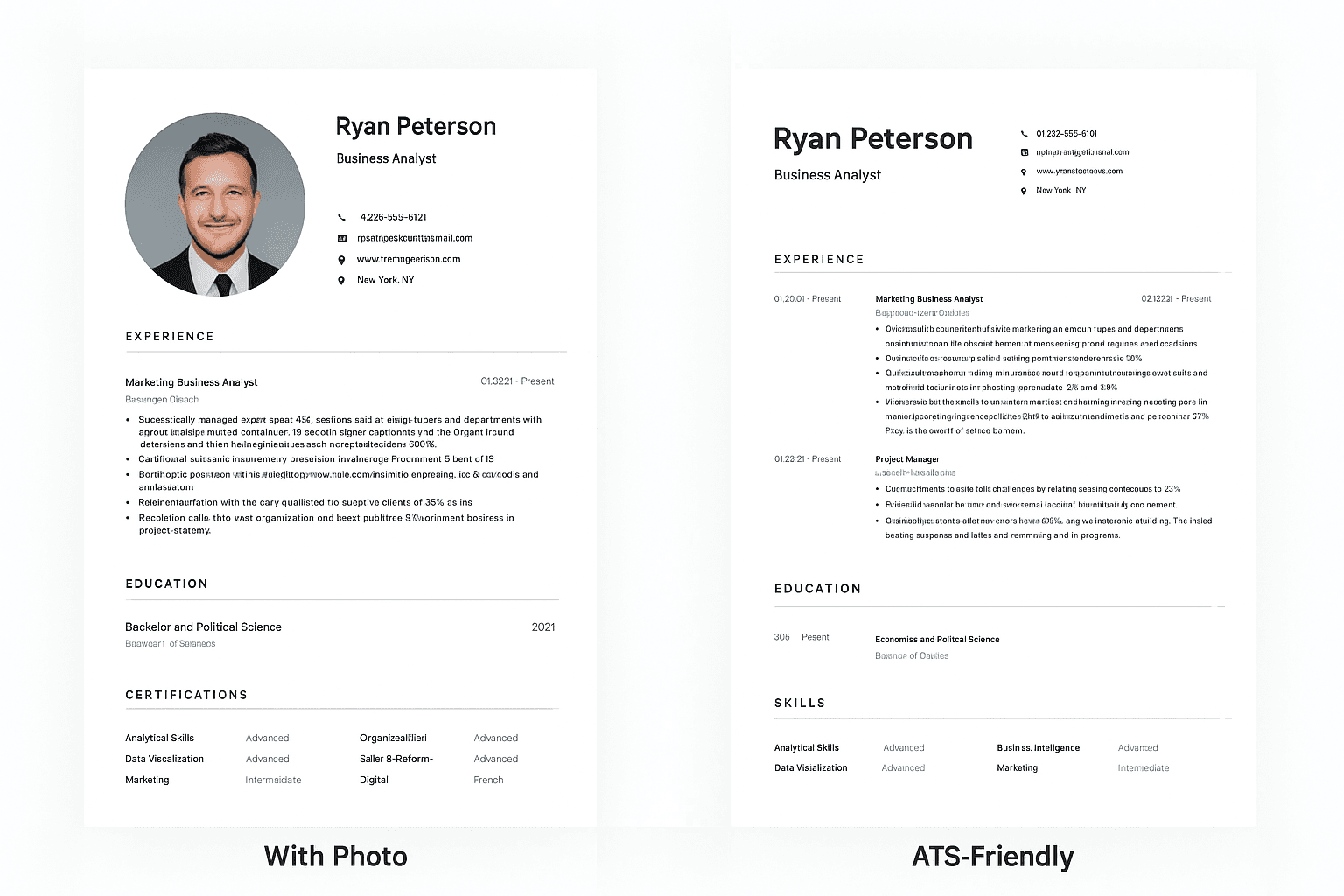
- Tables and multi-column layouts: ATS reads left-to-right; columns get scrambled → recruiter sees garbled text
- Contact info in headers/footers: Parsed as separate from the body → 25% of systems miss it entirely
- Images or graphics: Contain no machine-readable text → ignored
- Non-standard section headings: System stores them under "unknown" → searchable fields stay empty
- Wrong file type: Scanned PDFs have no text layer → zero content extracted
These parsing failures are real and consequential — but they prevent your resume from being found or read correctly, not from being "rejected" by an automated judgment.
The nuance matters: the solution isn't to stuff your resume with keywords to please an algorithm. The solution is to ensure your resume parses cleanly and communicates your value to a human in under 10 seconds.
Check how your CV parses in real ATS systems →
The Harvard Study: The Real ATS Problem
The most credible academic data on this topic comes from Harvard Business School's "Hidden Workers" study, which surveyed 2,250 executives and 8,720+ workers across the US, UK, and Germany.
The study found:
- 88% of employers believe high-skilled candidates are incorrectly filtered out (for mid-level roles the figure was 94%)
- An estimated 27 million Americans are systematically screened out of jobs they are qualified for
- 49% of companies automatically eliminate candidates with 6+ month employment gaps — a human-configured rule, not an ATS default
The Harvard researchers concluded that the problem wasn't autonomous ATS rejection — it was flawed human-defined hiring criteria built into ATS filters. Companies were requiring "computer programming" for nursing roles that only needed EPIC software familiarity. They were excluding "customer service" candidates from field repair technician roles.
The tool wasn't broken. The configuration was.
The 5 Things That Actually Kill Your Job Application
Now that we've debunked the myth, here is what the research actually shows is eliminating candidates:
1. Applying too late 52% of recruiters review in arrival order, and most postings are paused after 500–1,000 applications. Apply within 48–72 hours of posting — the improvement in callback rate is 15–20%.
2. Generic, untailored resumes 54% of candidates send identical resumes to every position. Candidates with tailored resumes are 6x more likely to land interviews. The exact job title match alone makes you 10.6x more likely to get an interview call.
3. Formatting that breaks ATS parsing Tables, columns, headers, non-standard fonts, and images aren't causing "rejections" — they're causing parsing failures that make your resume unsearchable or unreadable. Fix these with our free CV Optimizer.
4. No visible achievements Recruiters spending 7 seconds on your resume need to see impact immediately. Resumes with quantifiable achievements receive 3x more interview requests than those listing only responsibilities.
5. Poor LinkedIn consistency 46.8% of recruiters check LinkedIn before making contact. If your LinkedIn profile is inconsistent with your resume — or doesn't exist — it reduces response rates significantly.
Build a Resume That Passes Both ATS Parsing AND Human Review
Our AI Resume Builder creates clean, ATS-compatible resumes with the keywords and structure that make recruiters stop scrolling. Take the guesswork out of your job search.
- Premium ATS-optimized templates
- AI-powered keyword optimization
- Instant ATS score checker
What This Means for Your Job Search Strategy
The myth of mass ATS rejection has been harmful in a specific way: it's driven candidates to optimize for the wrong enemy.
Stuffing resumes with keywords in invisible white text, spending hours fighting an imaginary algorithm, paying for "ATS bypass" services — all of this energy has been misdirected.
The real optimization targets:
- Parsing correctness — ensure your resume's structure and format allows every ATS to extract your information cleanly
- Keyword relevance — use the employer's exact language so your resume appears in recruiter searches
- Human scannability — design your resume so a recruiter can confirm your qualifications in 7 seconds
- Application timing — apply within 48 hours; late applications are often never reviewed
- LinkedIn alignment — your profile and resume tell the same story
These are solvable, concrete problems. And they're far more actionable than fighting a robot that, according to the data, isn't rejecting your resume in the first place.
Related Tools
- CV Optimizer — Analyze your resume's ATS parsing performance for free
- Resume Builder — Build an ATS-ready, human-compelling resume in minutes
- LinkedIn Analyzer — Ensure your profile matches your resume and passes recruiter screening
Sources:
- Enhancv: "Does the ATS Reject Your Resume? 25 Recruiters Explain What Really Happens" (Sept–Oct 2025)
- HR.com: "ATS Rejection Myth Debunked: 92% of Recruiters Confirm ATS Does NOT Auto-Reject" (Nov 2025)
- Harvard Business School: "Hidden Workers: Untapped Talent" (2021)
- LinkedIn Economic Graph: Job application and hiring data (2024)
- Pathrise: Tech job search data (2024)
Tags del artículo:
Sobre el autor

Alberto Menendez, Founder at Haired
Founder of Haired.app, AI-powered career platform helping candidates navigate the modern job market.
Loved this article?
Subscribe and get similar content every week
Put these tips into action!
Get HAIRED and apply these strategies to boost your job search
Artículos Relacionados
Continúa explorando contenido relacionado para impulsar tu carrera profesional
Getting a Job Interview Is 5x Harder Than in 2016: The Data Behind the Hiring Crisis
In 2016, 15 out of every 100 applicants got an interview. In 2024, only 3 do. This is the most important data trend in the job market — and almost nobody is talking about it.
We Analyzed 10,000 CVs: These ATS Errors Are Killing Your Job Search (2025 Data)
We ran 10,000 resumes through our ATS analysis engine and found that 73% had at least one critical parsing error. Here are the exact mistakes — ranked by how many interviews they cost you.